
Museums and conservation
City Wall at Vine Street
See a preserved section of London’s wall and bastion foundations inside a modern gallery.
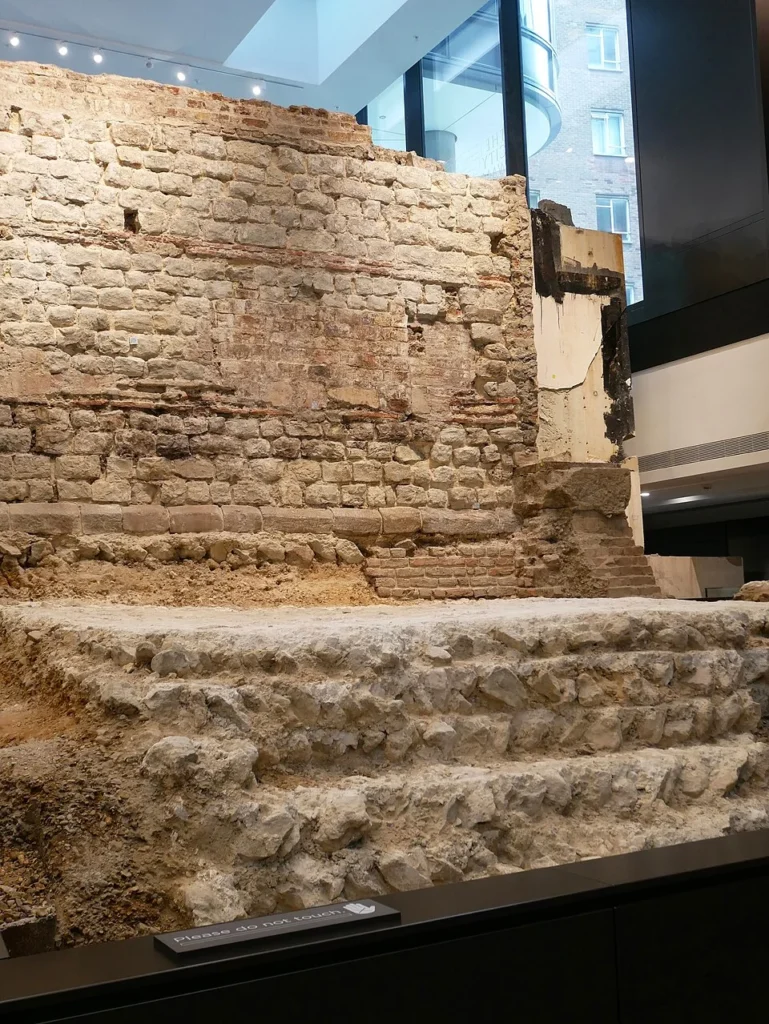

At Vine Street, a gallery beneath the modern city presents a section of the historic wall and the foundations of a Roman bastion. The visitor entrance is on Jewry Street. This is a useful place to investigate the city’s defences within a protected indoor setting.
The wall became absorbed into later buildings as London changed. Archaeological work in 1979 uncovered the section and bastion, and the present display places those remains beside objects recovered from the site. Their dates range well beyond Roman Britain, showing how a location can retain evidence from many periods.
Compare the wall’s mass and materials with the bastion plan. Ask which parts are visible above the gallery floor and which are explained through drawings. A surviving foundation gives evidence for a structure without preserving its complete original height.
The gallery combines archaeology, interpretation and modern public access. Check the operator’s current opening and group arrangements before visiting. Pair it with Tower Hill to compare how shelter, modern buildings and viewing distance affect the way an ancient wall is understood.
What to look for
- Connect the bastion foundations with the illustrated plan.
- Read object dates rather than assuming every display is Roman.
- Notice the modern supports and visitor route protecting the remains.
Plan a visit
Use the official information below for current opening, admission, access and any closures. Details can change with the season. A site plan is useful both before a visit and when reading the remains on the ground.
Sources and further reading
Romans in Britain · People · Places · Learning resources