
Read, question, discover
Learning resources
Colour, build, investigate and explore Roman Britain. Find free printables, hands-on activities and reading guides for home and the classroom.
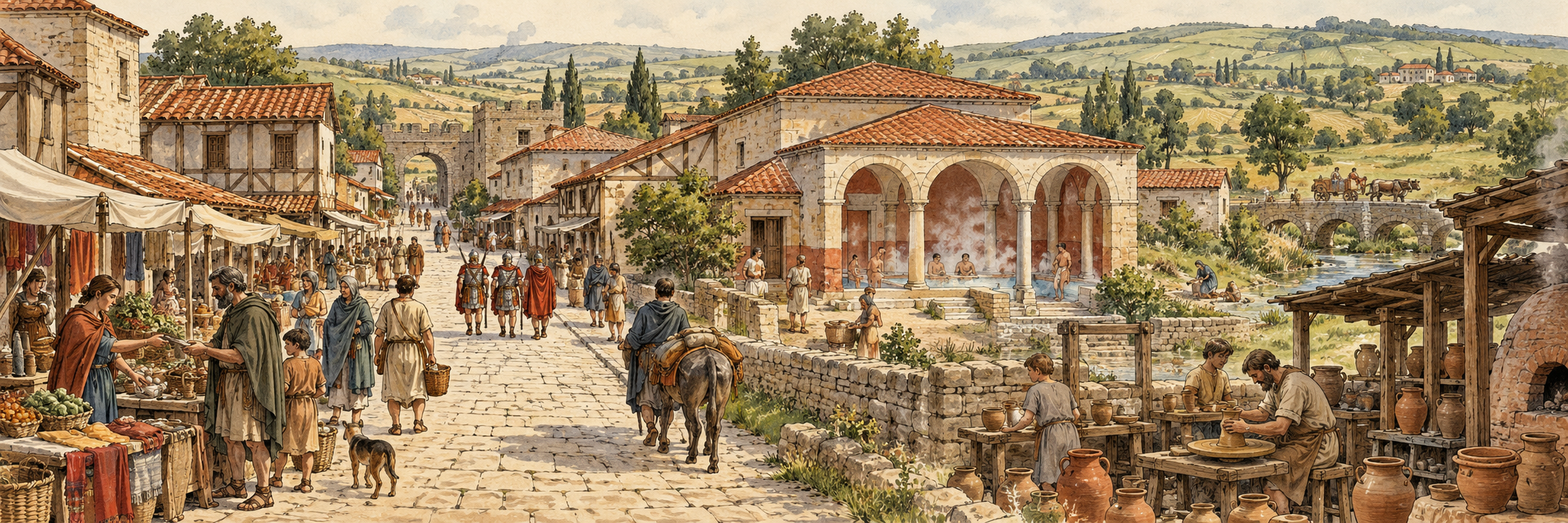
Choose your way in
Browse by activity type
Explore a collection, or use the age and search filters below to find a particular activity.
6 resources
Colouring sheets
Free Roman-themed colouring sheets for children, families and classrooms. Choose a shield, mosaic, pottery jar, fort gateway, cargo boat or coin design.
11 resources
Models to make
Cut, fold and build Roman-themed paper models: houses, towers, temples, boats, an aqueduct, street scenes and more.
8 resources
Crafts
Hands-on Roman craft projects to make at home or in the classroom, with practical instructions and printable guides.
19 resources
Explore and investigate
Ask questions, spot patterns and follow clues through Roman Britain. Explore activities for home, the classroom, museums and historic places.
20 resources
Source and object studies
Investigate Roman letters, inscriptions, coins and other surviving evidence through focused activities and discussion.
11 resources
Design and planning
Solve Roman-themed design challenges: plan a town, choose supplies, think about water or build a useful explanation.
5 resources
Recipes to make
Try modern kitchen adaptations of Roman recipes, with explanations of their historical starting points and practical ingredient choices.
36 resources
Reading guides and maps
Find timelines, maps, glossaries and introductions to Roman Britain, from roads and towns to communities, food and everyday life.
Find your next activity
Choose an age and a type, or search the whole collection. Suggested ages are a starting point: adapt the reading and tasks to your learners, with adult help where needed.
No matching resources. Try another age or type, or clear the filters.

Explore and investigate
Be a Roman number detective
Ages 7+ · Printable PDF
Decode numerals, finish a number trail and write a secret message. Includes an answer sheet.
Reading guides and maps
Browse Romans in Britain
Suggested ages 11+
Find people, places, learning activities, maps and reference guides from one starting point.

Models to make
Build a little Roman house
Ages 7+ · Printable PDF
A free three-page paper model with instructions, folding walls and a tiled roof to colour.
Design and planning
Build a museum object label
Suggested ages 7+ · Supported reading
Turn a catalogue record for a Roman mixing bowl into a clear label with claims that can be checked.

Models to make
Build a paper aqueduct arcade
Suggested ages 7+ with adult help · Printable PDF
Fold a freestanding arcade with two decorated sides and a water-channel deck.

Models to make
Build a paper cargo boat
Suggested ages 7+ with adult help · Printable PDF
Fold a small cargo-boat hull and add a paper mast and sail for a tabletop voyage.
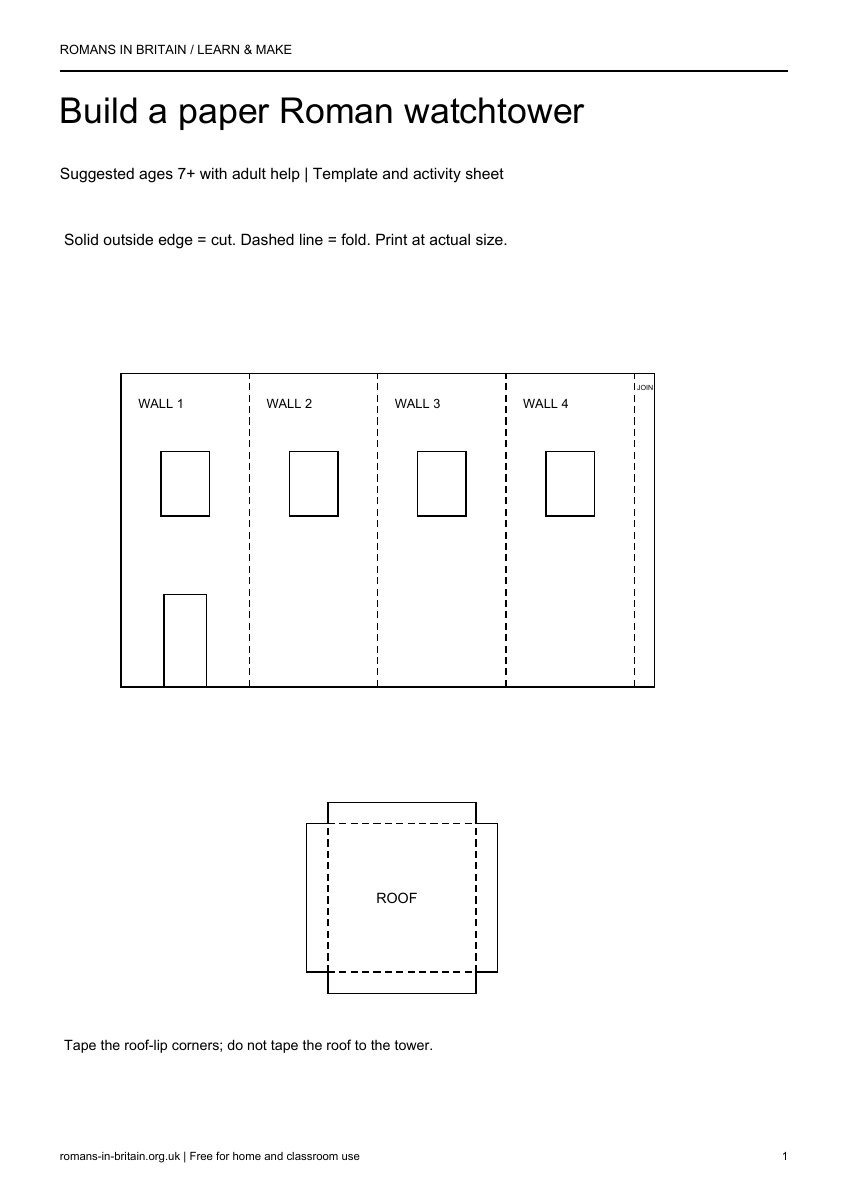
Models to make
Build a paper Roman watchtower
Suggested ages 7+ with adult help · Printable PDF
Build a four-sided tower with windows, a door and a removable roof cap.
Design and planning
Build a Roman Britain timeline
Suggested ages 7+ · Supported reading
Put people, places and changes in sequence, then distinguish an event from a period.
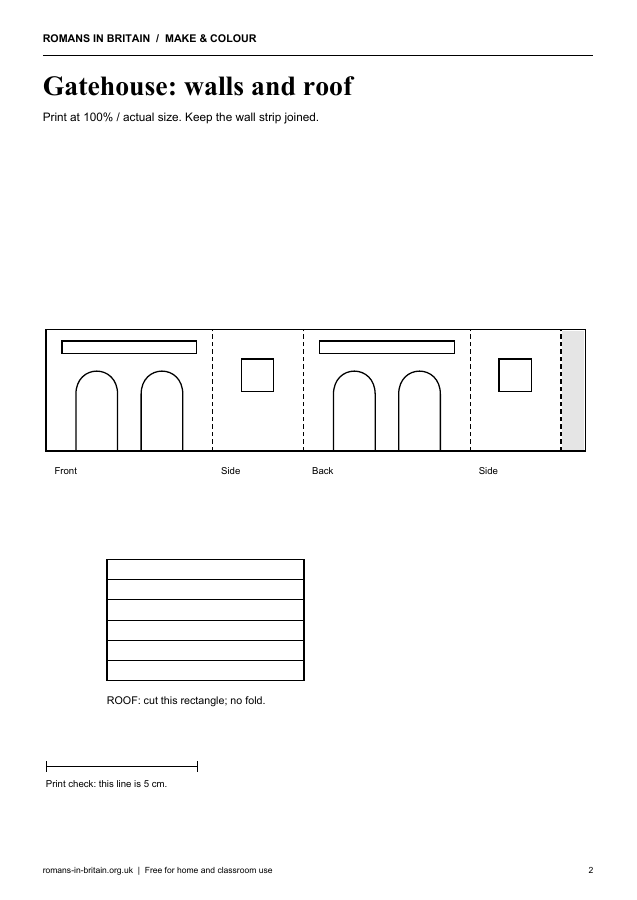
Models to make
Build a Roman gatehouse model
Ages 7+ · Printable PDF
Cut, fold and glue a small gatehouse, with a printable wall strip and removable roof.

Models to make
Build a Roman-style paper temple
Suggested ages 11+ with adult help · Printable PDF
Make a small gabled building with a columned front and a separate pitched roof.
Reading guides and maps
Caesar’s first expedition to Britain, 55 BC
Suggested ages 11+
Follow Caesar’s first Channel crossing, the difficulties his army faced and the difference between an expedition and a lasting conquest.
Reading guides and maps
Caledonians and Maeatae
Suggested ages 11+
Explore the northern peoples named in accounts of Roman campaigns, and the limits of those descriptions.
Design and planning
Choose a fort location
Suggested ages 7+ · Supported reading
Use Hardknott to weigh roads, terrain, water and supplies when explaining a military site.

Colouring sheets
Colour a cargo boat
Ages 5–7 · Printable PDF
Colour a sailing boat, decorate its cargo jars and imagine a voyage to Roman Britain.
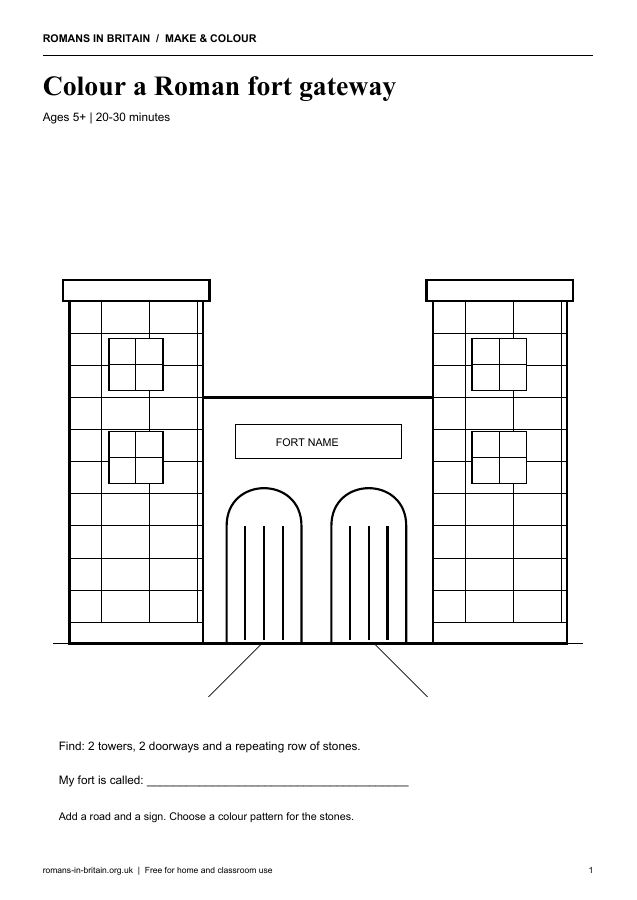
Colouring sheets
Colour a Roman fort gateway
Ages 5+ · Printable PDF
Colour a gateway, find matching shapes and design a sign for a Roman fort.

Colouring sheets
Colour a Roman mosaic
Ages 5+ · Printable PDF
Print a mosaic grid, colour a repeating border and invent a pattern in the centre.
Colouring sheets
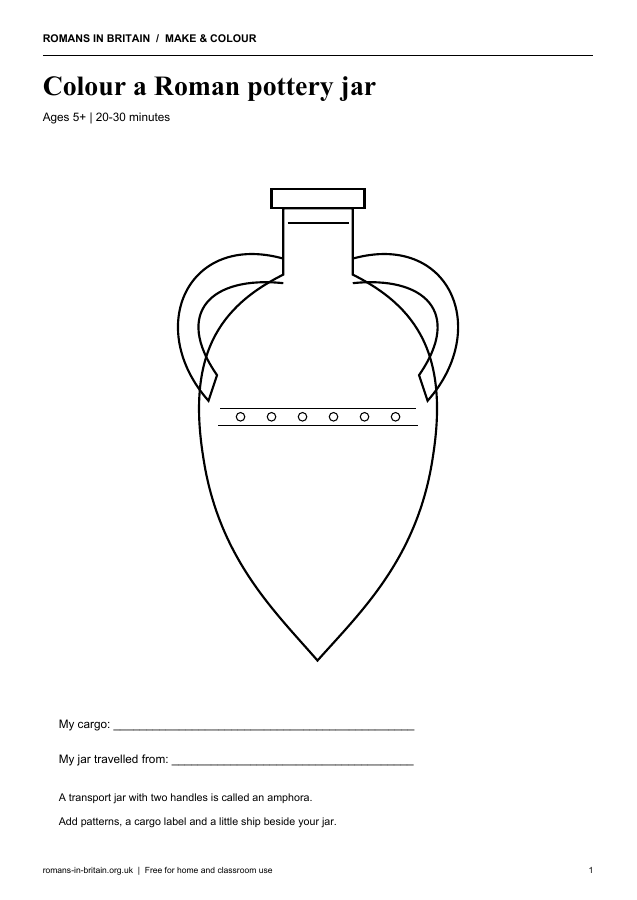
Colour a Roman pottery jar
Ages 5+ · Printable PDF
Colour a two-handled amphora, invent a cargo label and follow its journey to Roman Britain.

Colouring sheets
Colour your Roman shield
Ages 5+ · Printable PDF
A free A4 shield colouring sheet with lightning shapes, a central boss and room for your own symbols.
Explore and investigate
Compare a fort and a town
Suggested ages 7+ · Supported reading
Use Caerleon and Caerwent to explore military and civilian spaces while looking for connections between them.
Explore and investigate
Compare Hadrian’s Wall and the Antonine Wall
Suggested ages 7+ · Supported reading
Use two frontier landscapes to explore materials, geography and change over time.
Explore and investigate
Compare resistance and alliance
Suggested ages 11+
Investigate why different communities and rulers made different choices in their dealings with Rome.
Explore and investigate
Compare Roman pottery connections
Suggested ages 7+ · Supported reading
Use two museum records to investigate production, movement and the difference between a maker and an owner.
Explore and investigate
Compare timber and stone forts
Suggested ages 7+ · Supported reading
Use Lunt and Ambleside to distinguish original materials, buried traces and modern reconstruction.
Source and object studies
Compare two Roman sources
Suggested ages 11+
Set a personal letter beside a governor’s biography and ask what each can reveal.

Explore and investigate
Count at the Roman market
Ages 5–7 · Printable PDF
Count pottery jars, add missing jars and make your own market stall picture.
Design and planning
Design a Roman mosaic
Suggested ages 7+ · Supported reading
Observe a surviving floor, identify a repeat and make a design with a clear evidence trail.
Colouring sheets
Design your own coin
Ages 5–7 · Printable PDF
Draw both sides of a large coin and choose a symbol for something important to you.
Recipes to make
Eggs with pine-nut sauce
Suggested ages 7+ · Adult-led cooking
Make a small sweet-sour sauce inspired by an egg dish in Apicius, using straightforward modern quantities.
Design and planning
Explain a Roman hypocaust
Suggested ages 7+ · Supported reading
Trace heat beneath a floor and think about the work needed to keep a room warm.
Explore and investigate
Explore Pictish symbols
Suggested ages 7+ · Supported reading
Look closely at a carved stone, then create a paper symbol panel inspired by what you can see.
Reading guides and maps
Farming in Roman Britain
Suggested ages 11+
Look beyond the grand villas to the crops, livestock, households and changing landscapes that fed the province.
Explore and investigate
Find Roman walls in a castle
Suggested ages 7+ · Supported reading
Compare Pevensey and Portchester to investigate how later buildings reused Roman defensive enclosures.
Explore and investigate
Follow a find into a museum
Suggested ages 7+ · Supported reading
Trace the records, decisions and care that turn an excavated object into usable evidence.
Explore and investigate
Follow a Roman road
Suggested ages 7+ · Supported reading
Trace connections between places and test the clues used to identify an ancient route.

Design and planning
Frontier fort supply challenge
Suggested ages 11+ · Printable PDF
Allocate a limited delivery, respond to a delay and explain the limits of a supply model.
Recipes to make
Frontonian chicken with leeks and herbs
Suggested ages 7+ · Adult-led cooking
Try a modern version of pullum Frontonianum, a chicken dish preserved in the Apicius collection.
Reading guides and maps
Garum: Roman fish sauce and modern substitutes
Suggested ages 11+
Discover the evidence for a famous Roman seasoning, and how to explore its flavour in a modern kitchen.
Reading guides and maps
How a Roman legion was organised
Suggested ages 11+
Follow the relationship between tent groups, centuries, cohorts and a legion, without confusing paper strengths with a headcount.
Source and object studies
Investigate a Roman cavalry helmet
Suggested ages 7+ · Supported reading
Examine the Ribchester helmet as equipment for display, training and carefully staged military performance.
Source and object studies
Investigate a Roman coin
Suggested ages 7+ · Supported reading
Read a coin as an object, a means of payment and a message about authority.
Source and object studies
Investigate a Roman hoard
Suggested ages 7+ · Supported reading
Use groups of coins to distinguish a date of manufacture from a date and reason for burial.
Explore and investigate
Investigate Roman gods
Suggested ages 7+ · Supported reading
Compare evidence for worship at a temple, a town and a villa without treating belief as one uniform system.
Recipes to make
Julian pottage: a Roman-inspired grain dish
Suggested ages 7+ · Adult-led cooking
Make a simple meat-free grain pottage and compare it with the richer dish described in Apicius.
Reading guides and maps
Larks’ tongues and Roman banquet stories
Suggested ages 11+
Investigate a famous image of Roman excess, and learn to separate a striking food story from a securely identified recipe.

Crafts
Make a cardboard Roman shield
Ages 7+ · Printable PDF
Turn a cardboard box into a decorated shield, with a hand grip and an optional raised boss. Includes a printable guide.

Crafts
Make a decorative clay lamp
Suggested ages 7+ with adult help · Printable PDF
Shape an air-dry clay lamp ornament and decorate it with your own symbol.

Models to make
Make a mini Roman exhibition
Suggested ages 11+ · Printable PDF
Make three folding display stands, choose documented objects and write labels that distinguish evidence from ideas.

Crafts
Make a paper eagle standard
Suggested ages 7+ with adult help · Printable PDF
Colour an eagle topper, make a rolled-paper pole and design a small display standard.

Crafts
Make a paper laurel wreath
Suggested ages 5+ with adult help · Printable PDF
Cut paper leaves and make an adjustable wreath with a repeating leaf pattern.
Crafts
Make a paper mosaic tile
Suggested ages 5+ with adult help · Printable PDF
Turn coloured paper scraps into a mosaic picture with a repeating border.

Models to make
Make a paper Roman-style die
Ages 7–11 with adult help · Printable PDF
Cut and fold a cube net, add number spots and test your handmade die.

Crafts
Make a paper writing tablet
Ages 7–11 · Printable PDF
Create a foldable paper message tablet and compare it with Roman writing tools.

Models to make
Make a Roman milestone model
Ages 7+ · Printable PDF
Build a small standing road marker, add Roman numerals and make a route across your tabletop.

Models to make
Make a Roman road layer model
Suggested ages 11+ with adult help · Printable PDF
Fold and stack three paper layers to explore road construction and the limits of a simple model.

Models to make
Make a Roman street diorama
Suggested ages 7+ with adult help · Printable PDF
Fold a paper street corner with two upright walls, then draw shops and everyday life.

Crafts
Make a Roman-style theatre mask
Suggested ages 7+ with adult help · Printable PDF
Design an expressive paper theatre mask and use it to tell a short story.

Crafts
Make a Roman-style wall panel
Suggested ages 5+ · Printable PDF
Create a colourful wall panel with borders, blocks of colour and a central picture.
Source and object studies
Measure a Roman object from a catalogue
Suggested ages 7+ · Supported reading
Use a small pottery fragment to practise units, scale and the limits of a photograph.
Reading guides and maps
Milk-fed snails in Apicius
Suggested ages 11+
Read an unusual ancient food preparation as evidence for luxury, animal treatment and the challenges of recreating historical recipes.

Design and planning
Pack for a Roman journey
Ages 7–11 · Printable PDF
Choose supplies within a 10-point packing limit, explain your choices and solve a journey problem.
Recipes to make
Pickled cheese: history and a quick modern version
Suggested ages 7+ · Adult-led cooking
Explore an old cheese-preservation tradition, then make a small chilled dish using vinegar, honey and herbs.
Design and planning
Plan a Roman cargo journey
Suggested ages 7+ · Supported reading
Investigate pottery from the Thames estuary, then design and test a clearly fictional delivery plan.
Design and planning
Plan a Roman town
Suggested ages 7+ · Supported reading
Use Wroxeter and Corbridge to design a settlement and explain how its buildings depend on each other.
Design and planning
Plan water for a Roman settlement
Suggested ages 7+ · Supported reading
Create a water-supply proposal while considering baths, storage, maintenance and the evidence still needed.
Explore and investigate
Protect a Roman mosaic
Suggested ages 7+ · Supported reading
Use Brading and Bignor to investigate the choices involved in keeping fragile floors available to visitors.
Source and object studies
Read a military strength report
Suggested ages 11+
Use a Vindolanda document to distinguish a unit’s total, the men present and those fit for service.
Source and object studies
Read a Roman birthday invitation
Suggested ages 7+ · Supported reading
A message written around AD 100 offers a way to explore friendship, handwriting and the lives behind a Roman fort.
Source and object studies
Read a Roman building inscription
Suggested ages 7+ · Supported reading
Use the dedication from Hardknott to investigate names, missing letters and the evidence for construction.
Source and object studies
Read a Roman military diploma
Suggested ages 11+
Investigate a fragmentary record of service, citizenship and legal status found at Stannington.
Source and object studies
Read a Roman site plan
Suggested ages 7+ · Supported reading
Move between a plan and visible ruins, keeping remains and later additions distinct.
Source and object studies
Read a Roman trader’s letter
Suggested ages 11+
Follow the problems of buying, paying and transporting supplies in a letter from Octavius to Candidus.
Source and object studies
Read a soldier’s letter
Suggested ages 7+ · Supported reading
Separate orders, requests and uncertainties in a message from Masclus to a Vindolanda commander.
Source and object studies
Read a wall in phases
Suggested ages 11+
Use Tower Hill’s masonry to separate Roman construction, later additions and modern presentation.
Source and object studies
Read an Antonine Wall distance slab
Suggested ages 7+ · Supported reading
Use the Bridgeness slab to explore building records, imperial names and images of military power.
Source and object studies
Read animals in a Roman mosaic
Suggested ages 7+ · Supported reading
Observe an animal design closely, then compare your interpretation with the museum’s explanation.
Source and object studies
Read Regina’s tombstone
Suggested ages 11+
Use an epitaph, its carving and its two scripts to investigate one remembered life.
Source and object studies
Read Victor’s tombstone
Suggested ages 11+
Compare an inscription and a carved scene without assuming that either is a complete biography.
Explore and investigate
Reconstruct a lost coastline
Suggested ages 11+
Compare Reculver, Caister and Burgh Castle to see how changing water and land affect the reading of Roman sites.
Reading guides and maps
Religion and beliefs in Roman Britain
Suggested ages 11+
Explore gods, local traditions, temples and changing communities of worship across the province.

Explore and investigate
Roman bathhouse match and sort
Ages 7–11 · Printable PDF
Match Roman room names to their uses, then plan a bathing visit with paper cards.
Reading guides and maps
Roman battle tactics: formations and decisions
Suggested ages 11+
Understand how terrain, training, missiles, infantry and cavalry shaped a battle, and put the famous testudo in context.
Reading guides and maps
Roman Britain glossary
Suggested ages 11+
Find clear meanings for words used in our guides, including military terms, buildings, materials and historical evidence.
Reading guides and maps
Roman Britain timeline
Suggested ages 11+
Follow the changing relationship between Britain and Rome, from Caesar’s expeditions to the end of imperial government.
Reading guides and maps
Roman cooking: food, kitchens and ingredients
Suggested ages 11+
Discover how we investigate Roman meals, from cooking equipment and food remains to the recipes collected under the name Apicius.
Source and object studies
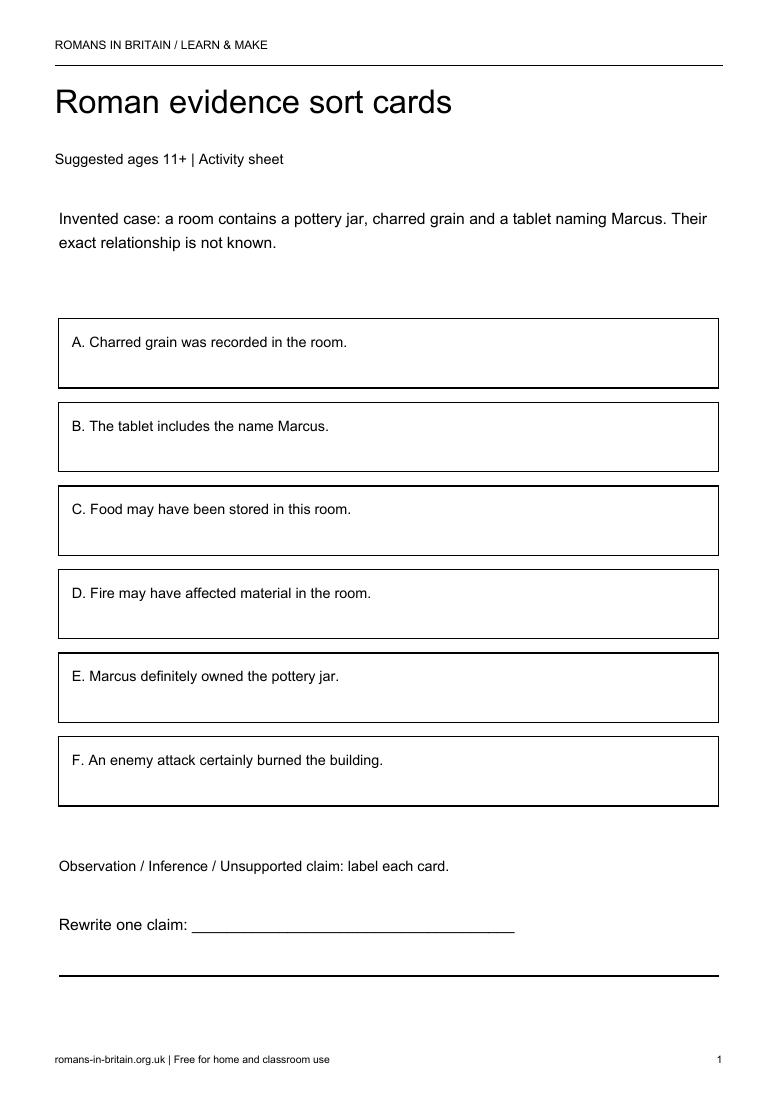
Roman evidence sort cards
Suggested ages 11+ · Printable PDF
Sort observation, inference and speculation using an invented archaeological case.
Reading guides and maps
Roman heating: how a hypocaust worked
Suggested ages 11+
Trace heat from a furnace beneath a raised floor and through flues, and discover the labour behind a warm Roman room.

Source and object studies
Roman inscription detective
Suggested ages 11+ · Printable PDF
Practise expanding abbreviations and separating surviving letters from reconstructed text.
Reading guides and maps
Roman London: map and guide to Londinium
Suggested ages 11+
Locate a selection of Roman sites beneath the modern City, from the amphitheatre and temple to walls and baths.
Reading guides and maps
Roman marriage and family life
Suggested ages 11+
Understand the difference between marriage, legal status and household power, and meet the limits of our evidence for Britain.
Reading guides and maps
Roman mining in Britain: metals, water and work
Suggested ages 11+
Discover why metal mattered to the province, using the gold workings at Dolaucothi as a starting point.
Reading guides and maps
Roman mosaics: patterns, pictures and places to see them
Suggested ages 11+
Learn how small pieces made large floors, and find mosaics in museums, town houses and villas across Britain.

Explore and investigate
Roman pattern play
Ages 5–7 · Printable PDF
Spot repeating shapes, finish mosaic borders and invent a pattern of your own.
Reading guides and maps
Roman recipes to explore and make
Suggested ages 11+
Choose a practical modern adaptation, or investigate the evidence behind a famous Roman food story.
Reading guides and maps
Roman roads of Britain: map and guide
Suggested ages 11+
Explore six major Roman roads, the towns they connected and the evidence for how the network was built.
Reading guides and maps
Roman shields: scutum, materials and use
Suggested ages 11+
Explore how Roman shields were made, how they were carried and why one famous shape cannot represent every Roman soldier.
Reading guides and maps
Roman soldiers: work, equipment and daily life
Suggested ages 11+
Meet the people behind the armour, from legionaries and auxiliaries to the families and workers around a fort.
Reading guides and maps
Roman towns in Britain: streets, buildings and communities
Suggested ages 11+
Read a Roman town through its streets, public buildings, houses and changing relationship with the surrounding countryside.
Reading guides and maps
Roman water supplies: springs, wells, pipes and drains
Suggested ages 11+
Explore how Roman communities obtained, moved and used water, from a household supply to a busy bath complex.
Recipes to make
Roman-inspired nut cake with honey
Suggested ages 7+ · Adult-led cooking
Bake a modern nut-and-honey cake, then investigate how it differs from the nut sweets in Roman recipe texts.
Reading guides and maps
Silures and Ordovices
Suggested ages 11+
Two distinct peoples associated with resistance to Rome in what is now Wales.
Design and planning
Supply a frontier fort
Suggested ages 7+ · Supported reading
Use Arbeia and Vindolanda to think through deliveries, storage and the people behind military supplies.

Explore and investigate
Take the Roman fort explorer challenge
Ages 6+ · Printable PDF
A printable looking, drawing and questioning sheet to use at a fort or with a site plan at home.
Reading guides and maps
The Atrebates
Suggested ages 11+
Explore a southern British community through Calleva, rulers’ coins and connections across the Channel.
Reading guides and maps
The Brigantes
Suggested ages 11+
A major northern people whose rulers pursued both alliance with Rome and resistance to it.
Reading guides and maps
The Catuvellauni
Suggested ages 11+
Explore a powerful southern group through rulers, coins and the struggle over Roman conquest.
Reading guides and maps
The Deceangli
Suggested ages 11+
Meet a community associated with north-east Wales, known through Roman campaigning and the evidence of lead production.
Reading guides and maps
The Dobunni
Suggested ages 11+
Meet the communities of the Cotswolds and Severn region through Bagendon, coinage and Roman Corinium.
Reading guides and maps
The Durotriges
Suggested ages 11+
Discover the communities of Dorset and neighbouring areas through settlements, pottery, coins and burial evidence.
Reading guides and maps
The Iceni
Suggested ages 11+
An East Anglian people whose history includes wealth, dealings with Rome and the revolt led by Boudica.
Reading guides and maps
The Picts
Suggested ages 11+
Meet the peoples of northern and eastern Scotland through Roman accounts, Pictish art and a history that continued beyond Roman rule.
Reading guides and maps
The Roman soldier’s tunic
Suggested ages 11+
Look beneath the armour at a practical garment, and explore what textiles can and cannot tell us about military clothing.
Reading guides and maps
The Trinovantes
Suggested ages 11+
A people of eastern Britain connected with Camulodunum, shifting power and Boudica’s revolt.
Source and object studies
Trace a Roman food container
Suggested ages 7+ · Supported reading
Follow an amphora from its material and shape to questions about transport, trade and the limits of a cargo story.
Explore and investigate
Trace connections across the empire
Suggested ages 7+ · Supported reading
Map named people and objects without inventing journeys the evidence does not record.
Explore and investigate
What happened after Roman rule?
Suggested ages 11+
Compare later activity at Birdoswald with the end of a villa to explore change without assuming one date explains every place.
Reading guides and maps
Who were the Celts?
Suggested ages 11+
Understand a familiar name for languages, art and identities without turning ancient Britain into one tribe.
Our printable sheets are free for home and classroom use. Print in black and white on A4 paper. Models should be printed at actual size; ask an adult to help with cutting.
Read, question, discover
Bring Roman Britain into focus.
Start with these museum and university resources. Follow the links for activities, object studies and ideas for learning together.
British Museum · Ages 7–11
Life through objects
Explore coins, pottery, writing and other traces of life in Roman Britain with the British Museum’s school resources.
Browse ancient Rome resources →University of Cambridge · Primary activities
Conquest and everyday life
Try activities about the conquest of Britain, Roman emperors and the objects and habits that arrived with Roman rule.
Explore the learning activities →British Museum · Video and lesson ideas
Ask a Roman expert
What did people do in their free time? How did you join the army? Let a museum curator answer questions about the Roman world.
Watch the History Hotline →Follow people into the landscape
Person · Roman emperor
Claudius
The emperor who ordered the invasion of AD 43, connecting imperial politics with the early conquest of Britain.
Place · Kent
Richborough Roman Fort
Invasion-period ditches, a Roman port town and later fort walls near Sandwich.
Place · Somerset
Roman Baths
The hot spring, temple and bathing complex of Aquae Sulis, in the heart of modern Bath.
Conquest and resistance
Boudica
Read about the Iceni leader and the revolt against Roman rule.
Emperors and frontiers
Hadrian
Connect an emperor’s visit to Britain with the frontier that bears his name.
Homes and mosaics
Fishbourne Roman Palace
Look at surviving floors and explore what they reveal about a Roman household.
Sources and collections
Each profile names the sources used for its account. Follow museum and heritage collections to examine objects and places more closely.
Museum collection
Roman Britain at the British Museum
Explore objects from Roman Britain and the lives they illuminate.
Heritage sites
Hadrian’s Wall history
Read about soldiers, civilians and the frontier with English Heritage.
Archaeology and visiting
Fishbourne with Sussex Past
Find the official visitor information for the palace, mosaics and gardens.
Romans in Britain · People · Places · Learning resources